The most popular advice for medicinal mushrooms near me is to open a map and walk into the closest shop. Distance is a poor proxy for safety. A storefront two blocks away might sell a fruiting-body extract with a lot number, a grain-grown mycelium powder with no amounts listed, a culinary mushroom, or a psychedelic session your city does not allow. Proximity tells you almost nothing until you sort the product category, read the label, check the legal status, and match the product to your medicines. Start there, not with the pin.
Table of Contents
- Where to Find Medicinal Mushroom Products Near You
- Regulation and Evidence Set Realistic Expectations
- Read the Label and Screen Your Medications
- Fresh and Wild Mushrooms Need Different Checks
- Legal Access for Psychedelic Mushroom Services
- Choose a Source by Your Goal
Where to Find Medicinal Mushroom Products Near You
A search for medicinal mushrooms near me returns several kinds of sellers, and the first check depends on which kind you found. Use this as the working map.
| Source | What You Typically Find | First Question to Ask |
|---|---|---|
| Health food or supplement store | Capsules, powders and extracts from established brands | Which species is it, and what extract ratio does the label list? |
| Functional mushroom dispensary | Powders, teas and tinctures sold for everyday wellness use | Is it sold as a dietary supplement, and where is the certificate of analysis? |
| Online retailer | Extracts, powders and teas shipped to your address | Does the seller publish lot-level testing and a physical business address? |
| Psychedelic therapy or integration practice | Supervised sessions and preparation support, not retail products | Is the practice licensed where it operates, and what exactly does the service include? |
| Grower, farmers market or fresh-mushroom seller | Fresh culinary mushrooms and home-grown products | Is it sold as food, and how was the species identified? |
| Cultivation equipment supplier | Grow kits, substrates and lab tools for home cultivation | Does it sell supplies only, or also finished supplements? |
A health food store usually stocks branded capsules and extracts. The extract ratio is the first filter, because a name like reishi on the front does not tell you the strength inside.
A functional mushroom dispensary leans toward powders, teas, and tinctures framed as everyday wellness. Ask whether the item is a dietary supplement and whether a certificate of analysis sits behind that lot.
An online retailer can ship extracts without a shop you can visit. A published lot test and a real business address are the minimum. A checkout page alone is not a company.
A therapy or integration practice sells time and supervision, not a jar. License and a written description of the service matter more than a glowing testimonial.
A grower or market stall is selling food. Species identification is the question, not a wellness slogan.
An equipment supplier should be selling kits, substrates, and tools. If the same counter also pushes finished capsules, treat those capsules as a separate product with a separate label check.
We built the directory so you can search products, services, businesses, and events near you or online, then compare options and connect by reaching out, shopping, booking, or joining. Browse by Dispensaries, Functional Mushrooms, Buy Online, Therapists, Growers, and Equipment, then narrow by location. The functional mushrooms category is the right shelf when you want everyday supplements rather than a session or a grow kit. A listing confirms that a business exists and describes what it does. It does not mean we tested the bottle.
Practical rule: Pick two or three sources that match the product you actually want, and write down the first question for each before you spend anything.
Regulation and Evidence Set Realistic Expectations
A bottle on a shelf, a jar in a dispensary, or a listing on a marketplace is usually a dietary supplement, not an approved medicine. Availability is not an evaluation. The shop being two blocks away changes nothing about that.
The National Cancer Institute states that dietary supplements are regulated by the U.S. Food and Drug Administration as a separate category from foods, cosmetics, and drugs, and generally do not require FDA premarket evaluation and approval unless they make specific disease-prevention or treatment claims. FDA Good Manufacturing Practices still require finished supplement batches to meet specifications for identity, purity, strength, composition, and contamination limits. Manufacturing standards can apply while an effectiveness approval does not. A clean facility and a proven benefit are two different questions.
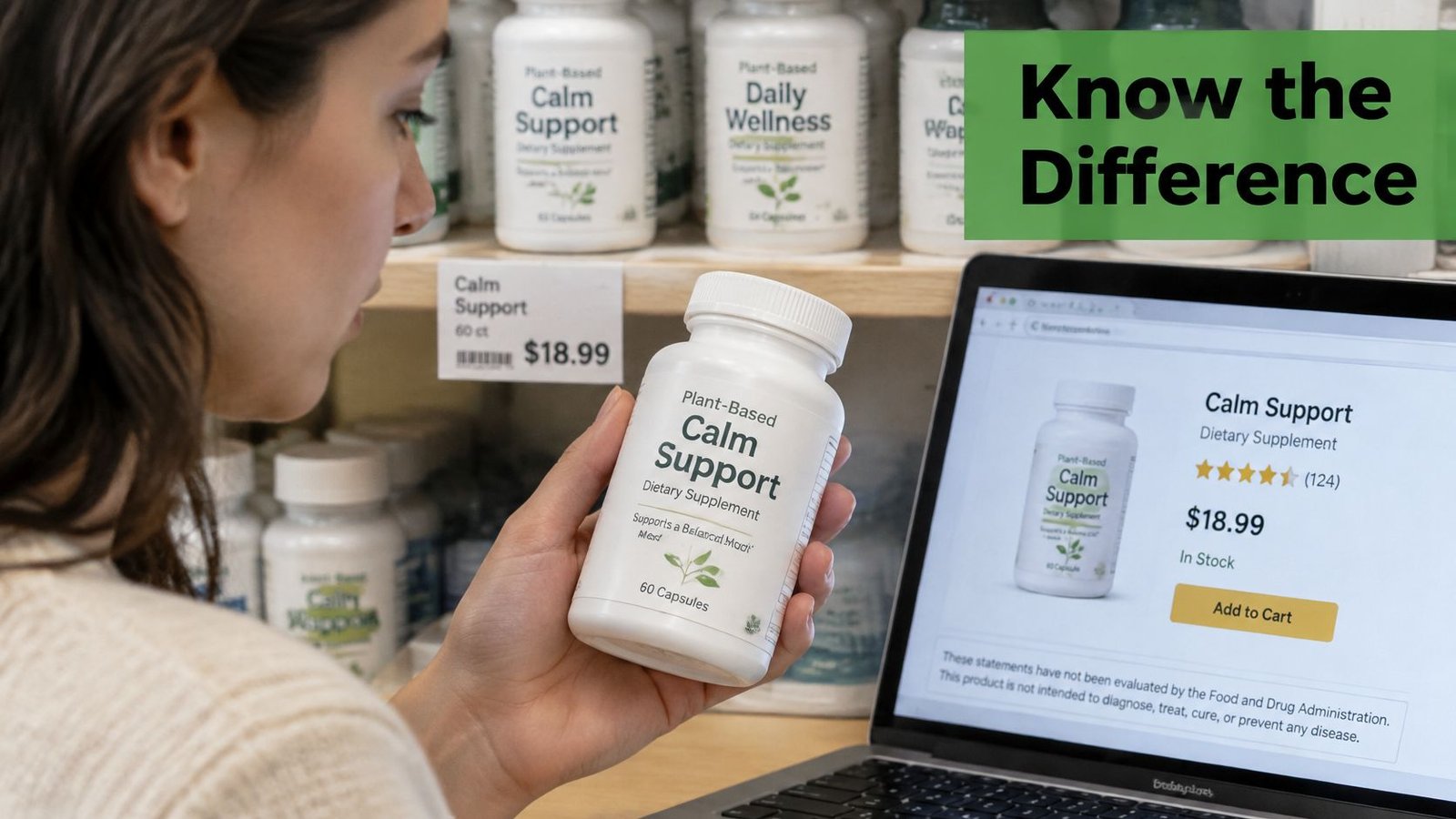
What approval does not cover
The same National Cancer Institute page reports that FDA has not approved medicinal mushrooms as a treatment for cancer or any other medical condition. The label reflects that status: a supplement cannot claim to diagnose, treat, cure, or prevent a disease unless FDA has evaluated that claim, so the packaging carries wording that the product has not been evaluated for those purposes. If a local seller skips that line and talks like a pharmacy, the claim is running ahead of the category. Walk away.
Sort every item into one of three buckets before you compare prices.
- Food: a culinary mushroom sold to eat, judged by species identity and food handling.
- Dietary supplement: capsules, powders, tinctures, and extracts, judged by identity, dose, and batch quality, not by a disease approval.
- Clinically approved drug: a medicine with a premarket efficacy review. A mushroom capsule in a wellness shop is not in this bucket.
What the human trials can carry
A scientific review of the clinical literature reports that most human research consists of pilot studies or Phase I and Phase II trials with small participant groups, which limits statistical power and how far findings travel. The same review flags standardization, because extracts vary in composition, concentration, and preparation method. A result tied to one lion's mane extract, one reishi preparation, or one turkey tail product does not transfer to the next jar with a similar common name.
| Evidence Type | What It Can Show | Main Limit |
|---|---|---|
| Laboratory studies | Biological activity of specific compounds in cells | Does not show what happens in a human body |
| Animal studies | Effects in living organisms under controlled conditions | Results may not transfer to people or to a commercial dose |
| Pilot human studies | Early signals on tolerability and direction of effect | Small groups limit statistical power |
| Phase I and Phase II trials | Dosing, safety and early effect patterns | Rarely large enough to generalize to wider populations |
| Controlled human trials with consistent products | Stronger evidence for a specific extract and use | Few exist, and results apply only to the tested product |
Run this test on any benefit claim a seller repeats. Which species and which extract were studied? How many people took part? What did the comparison group receive? Did the evidence come from a lab, an animal, or a human trial? Traditional use and a cell study are not a treatment. A seller who cannot answer the first question has told you what the jar is worth.
Read the Label and Screen Your Medications
The species name on the front is not the product. Two bottles both labeled reishi can differ in the part used, the solvent, the dose, and what dissolves when you swallow it.
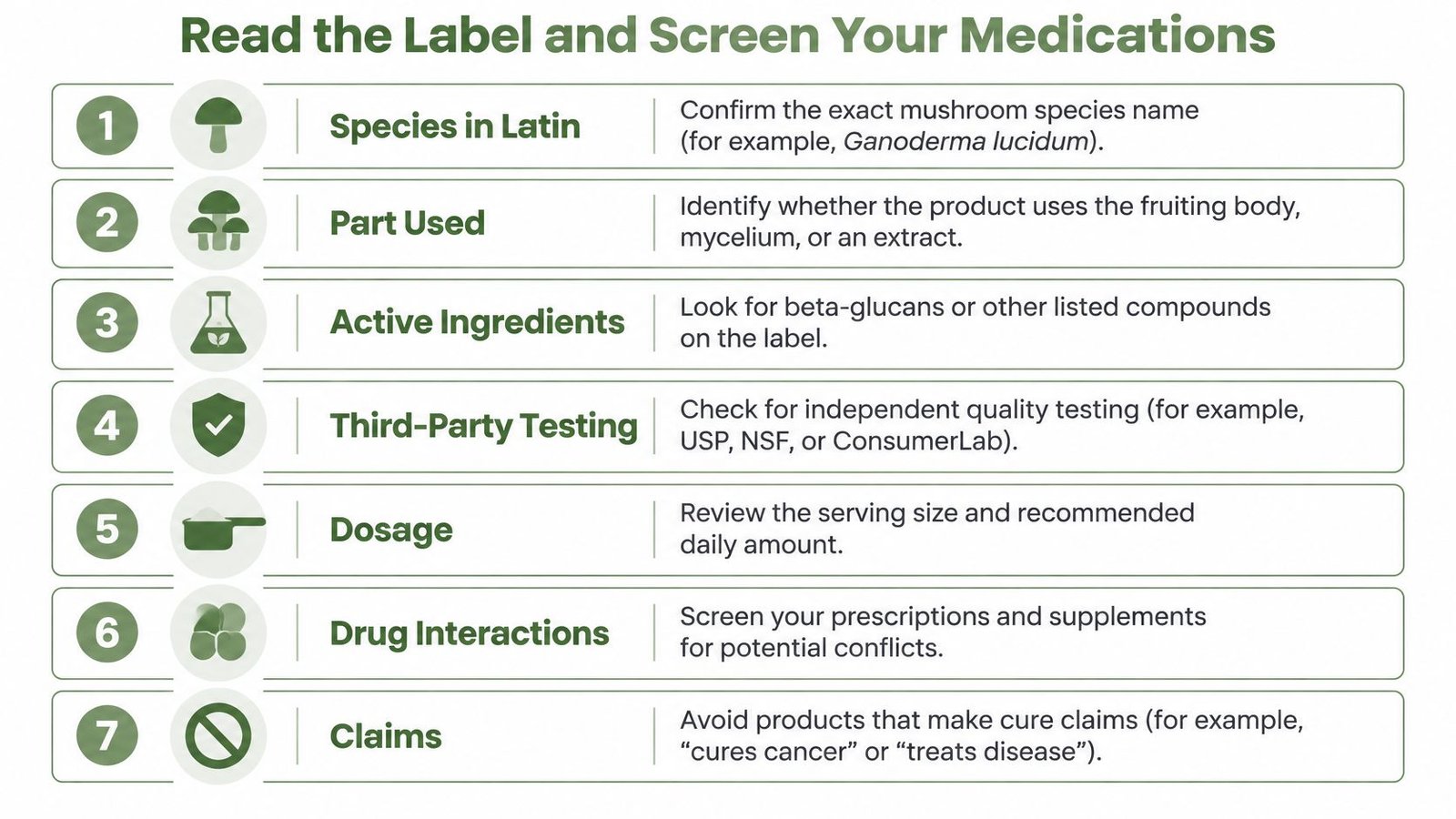
Seven checks before you pay
Work through these in the aisle or on the product page.
- Species in Latin. You want Ganoderma lucidum for reishi or Hericium erinaceus for lion's mane, not a nickname alone.
- Part and form. Fruiting-body powder, mycelium grown on grain, hot-water extract, and alcohol extract are different products. Say which one the label names.
- A number for the active fraction. Ask for quantified beta-glucan content and the extract ratio. "Immune support" is a slogan.
- Milligrams per serving. A blend that hides every amount fails this check.
- Lot number and a certificate of analysis covering heavy metals and microbes for the lot you would buy.
- Manufacturer name and address. A brand with no place to write is a brand you cannot trace.
- Disclaimer and contraindications. The disease disclaimer should be present, and so should any warning the maker is willing to print.
β-glucans are structurally diverse fungal polysaccharides, and a review of their clinical use notes that immune effects depend on branching, solubility, molecular weight, extraction method, and oral bioavailability, so two products with the same mushroom name may not be pharmacologically equivalent. That review of fungal β-glucan trials in cancer patients identified 16 studies involving 1,650 participants, with generally good tolerability, methodological diversity, and inconsistent statistical significance. Adjunctive findings are not proof that an over-the-counter powder treats cancer, infection, or diabetes.
Red flags are blunt. Cure language, a proprietary blend with no milligrams, a missing species, or a refusal to show the certificate for the lot in your hand. Walk away. A seller who cannot answer species, extract ratio, beta-glucan content, lot testing, and contraindications is not a safe first source, however close the shop is.
A reishi tea recipe is a useful contrast. Tea is a preparation you control. A tincture with no solvent, no ratio, and no lot test is a product you are asked to trust.
Medicines that change the decision
"Natural" is not pharmacologically neutral, and it is also not proof that every mushroom supplement is dangerous. A Frontiers in Nutrition review notes that mushroom constituents may affect drug absorption and metabolism through cytochrome P450 pathways, while most interaction evidence remains preclinical, and long-term safety is poorly characterized because many human studies last 12 weeks or less. That guidance flags hypoglycemia, hypotension, bleeding risk, immunosuppressants, chemotherapy, tamoxifen, and surgery, and reports insufficient safety information during pregnancy and lactation.
| Situation | Why It Matters | What to Do |
|---|---|---|
| Glucose-lowering medicines | Possible low blood sugar | Ask a clinician before starting and monitor levels |
| Anticoagulants or antiplatelet drugs | Possible bleeding risk | Get clinician approval before starting |
| Immunosuppressants | Possible interference with immune-suppressing treatment | Do not self-start without specialist review |
| Chemotherapy or tamoxifen | Interaction concerns during active treatment | Coordinate with the oncology team |
| Planned surgery | Bleeding and timing concerns | Tell the surgical team and follow their advice on stopping |
| Pregnancy or breastfeeding | Insufficient safety information | Avoid unless a clinician approves |
| Liver disease | Rare serious liver reports with some extracts | Discuss with a physician before use |
A separate safety review describes generally good tolerance for preparations of Ganoderma lucidum, Trametes versicolor, Cordyceps sinensis, and shiitake, and also notes rare reports of serious liver dysfunction associated with some Agaricus blazei extracts, with causality not always established. Bring the printed label to a pharmacist or clinician. A verbal "it's reishi" is not a medication review.
This short walk-through shows how to read a supplement panel before you treat a nearby shop as a recommendation.
Fresh and Wild Mushrooms Need Different Checks
Culinary mushrooms and wild collections are not the same purchase. A foraged mushroom can be confused with a toxic lookalike, and some toxic species cause severe, delayed organ damage. Do not eat a wild mushroom identified from a photo or from a seller's word alone.
You have three realistic paths.
- Buy cultivated food. Choose fresh mushrooms sold as food, and ask the grower how the species was identified.
- Grow your own from supplies. Kits and substrates from an equipment seller keep you on a known culture instead of a trailside guess.
- Use a local mycological society. A trained identifier can check a specimen before anyone cooks it. Our mushroom picker's guide is the place to start that habit, not a substitute for an in-person ID.
Keep the checks short. Confirm it is sold as food. Ask for the species in Latin. Ask how identification was done. If you are holding a wild find, keep a sample for an expert rather than eating first.
A mushroom sold locally is not automatically safe to eat raw or unprocessed.
If someone eats a wild mushroom and feels unwell, contact a local poison control center or emergency services immediately. Bring the specimen or a clear photo. A guess about the name wastes the time that matters.
Legal Access for Psychedelic Mushroom Services
Search results smash four different things into one phrase: functional supplements, illicit psychedelic sales, decriminalization, and regulated therapeutic access. Those are not interchangeable, and a dispensary sign does not sort them for you.
A Washington Liquor and Cannabis Board research brief describes the split. Psilocybin remains illegal federally and in most states. Oregon and Colorado have regulated forms of supervised access with minimum-age and licensing requirements. Local decriminalization or deprioritized enforcement generally does not create a lawful retail market, and it does not authorize unlicensed sale.
| Jurisdiction | Legal Status | Access Rules |
|---|---|---|
| Federal level | Illegal | No federal licensed retail route |
| Oregon | Regulated supervised access | Licensed service centers and related licenses, adults 21 and older |
| Colorado | Regulated supervised access | Licensed frameworks with cultivation and testing licenses, adults 21 and older |
| Most other states | Illegal | Local decriminalization or deprioritized enforcement does not authorize sale |
What a regulated framework actually is
Oregon and Colorado point toward supervised, licensed models, not ordinary retail. Those frameworks include service-center, cultivation, and testing-related licenses, and access is restricted to adults 21 and older. A delivery ad, a cash-only jar, or a "ceremony near you" post is a different legal object.
Label every listing before you inquire. Functional supplement. Culinary product. Cultivation supply. Licensed psychedelic service. Therapy or integration support. Unverified claim. Then ask which license covers the service and whether that license applies in the city where the session would happen. Check the number, don't collect the vibe.
A psychedelic offer advertised locally without a verifiable license is unverified, no matter how many reviews it displays.
Choose a Source by Your Goal
Buy for the job, not for the shortest drive.
If you want an everyday functional supplement, finish the label checks and the medication screen, and buy only from a seller who can produce the certificate of analysis for that lot. If you want to cultivate, start with equipment and grow education, and keep wild collection as its own safety question. If you want fresh culinary mushrooms, confirm the sale is food and the species is identified. If you want supervised psychedelic support, verify the license and the adult age rule in the state where the service operates.
- Shortlist two or three sources from the first table. Treat directory listings, including ours, as a starting list, not a lab report.
- Send the label and testing questions in writing. A seller who answers only by phone is harder to hold to a lot number.
- Compare the written answers and check any license number against the jurisdiction where the service is offered.
- Talk with a clinician before the first dose if you take glucose-lowering drugs, blood thinners, immunosuppressants, chemotherapy, or tamoxifen, or if surgery, pregnancy, or liver disease is in the picture.
Keep the receipt and the lot number with the product. If something goes wrong, you need a batch, not a neighborhood.
Mushrooms For Sale is a directory for functional mushroom sellers, growers, equipment suppliers, therapists, and related mushroom businesses, searchable near you or online. Use it to shortlist the kind of source that matches your goal, then run the label, testing, medication, and license checks before you pay. Visit Mushrooms For Sale and compare the listings that fit what you want to buy.