Between November 18, 2025 and March 17, 2026, public-health investigators in Northern California documented 39 suspected amatoxin poisonings among people who ate foraged wild mushrooms. Three of those patients needed liver transplants, and four died, according to the CDC's Morbidity and Mortality Weekly Report. That's a case series from a region with a deep foraging culture, an active mycological community and no shortage of field guides for sale.
The failures that kill foragers rarely look like failures at the time. Amatoxins don't taste bitter, don't reliably change the smell or colour of a dish, and for the first several hours they produce nothing worse than what feels like a mild stomach bug. The mushroom gets eaten, the symptoms arrive late, and the decision that matters gets made in a kitchen rather than in the woods.
Two gaps sit on either side of identification, and most picking advice skips both. One is the phone in your pocket returning a species name with unearned confidence. The other is the twelve hours after a suspect meal, when a forager decides whether to wait it out. A mushroom pickers guide worth carrying handles both, and it treats identification as a documented process rather than a resemblance you remember.
Table of Contents
- Why Identification Comes Before Every Pick
- Prepare Your Kit and Pre-Trip Checks
- Field Features That Separate Edible From Dangerous
- How to Confirm an Identification Step by Step
- Look-Alike Pairs That Cause Most Poisonings
- Apps, Books and Experts as Screening Tools
- Harvesting, Handling and Storing Your Haul
- What to Do If Symptoms Start Hours Later
Why Identification Comes Before Every Pick
Poisoning from wild mushrooms is measured in thousands of medical encounters a year, not in anecdotes. A review published in Fungi Magazine reports approximately 7,000 reported mushroom poisonings annually in the United States, about 700 of which involve significant harm, and records 52 deaths in the cited data.
Reporting systems count different things and set different thresholds for what qualifies as a case. What the figures establish is scale: poisonous-mushroom exposure is a routine public-health event, and it reaches foragers with real experience, not only careless beginners.
The assumption worth attacking is the one nearly every new picker carries, that a familiar-looking mushroom is safe to eat. Familiarity is the least reliable identification tool there is, because it is built from photographs, supermarket shelves and half-remembered advice. A yellow cap with gills is a description, not a name.
A cap that resembles a chanterelle is not a chanterelle. Identity comes from characters you recorded on the specimen, not from a resemblance you remember from a photo.
This is why the strongest references are regional rather than universal. A good regional guide is built around the species that fruit where you walk, with seasonal timing, key identifying characteristics, habitat, look-alike warnings and local search practices. Carry a guide written for another region and you inherit its species list without its local dangers.
Everything else in safe picking elaborates on six things:
- Field characters that carry real weight, and the popular ones that do not
- A documented workflow with a stop condition built in before the kitchen
- Look-alike pairs where one character separates dinner from a hospital admission
- The actual accuracy of apps and books, and how to use each as a screening tool
- Handling and storage that stop one bad specimen spoiling a good batch
- Delayed-onset poisoning, because the timeline belongs inside the picking workflow
Two decisions belong before your first trip. The first is whether you forage for personal use only, because sharing, serving or selling a harvest pulls jurisdiction-specific rules into the picture. The second is who you will call when something is wrong: a local mycological society, a qualified identifier, and your regional poison-control number, saved in your phone rather than bookmarked. If you are starting from zero, our foraging safety tips cover the groundwork.
Prepare Your Kit and Pre-Trip Checks
Ten minutes of preparation at home removes most of the improvisation from a foraging trip. These six checks are worth completing before the car leaves the driveway.
- Carry two references, both offline. Save the regional taxonomic key you'll use and one independent second source. Download or print both, because woodland signal is unreliable and a browser tab isn't a field reference.
- Line up a human confirmer. Contact a local mycological society, or find a qualified identifier willing to look at specimens and spore prints. Get the contact details before you need them. If you're assembling a reference shelf, the Learn & Grow Journal carries articles such as 'Foraging Safety Tips' alongside 'Beginner's Guide to Lion's Mane' and 'How to Start Growing at Home'.
- Program the numbers. Poison control and your local emergency number go into your phone, and note the nearest hospital with an emergency department along your route.
- Pack for airflow and separation. An open basket or mesh bag, a knife for cutting at the base, a soft brush, one paper bag per species, a notebook and a camera. Our guide to the mushroom hunting basket covers what earns its place and what doesn't.
- Confirm you're allowed to be there. Public parks, private woodland and protected areas follow different rules, and those rules often change with species and volume.
- Check the season and the recent weather. A dry spell, a hard frost or three days of heavy rain reshuffles which species are fruiting and where.
Settle one question before you start walking: is this outing for personal use only? The moment a harvest is shared, served or sold, a stricter set of rules applies, and most foragers underestimate how strict.
Field Features That Separate Edible From Dangerous
Identification is a checklist, not an impression. Six feature groups carry most of the decision, and they don't carry equal weight.
| Feature | What to Check | What It Tells You |
|---|---|---|
| Habitat and substrate | Wood, soil, lawn or dung, and nearby tree species | Narrows candidate species to those that grow on that material |
| Cap | Shape, colour, surface and whether it peels | Basic starting point only, since colour shifts with age and weather |
| Gills, pores or ridges | Attachment to stem, spacing, colour, and true gills versus blunt ridges | Separates many groups and exposes some look-alikes |
| Stem and ring | Length, bruising colour, and whether a ring is present | Helps confirm group, though rings can be lost with age |
| Volva at the base | Whole base dug out to check for a cup or sac | Often missed when specimens are pulled out carelessly |
| Odour and flesh | Smell and cut-flesh colour | Supports other features and never decides identity alone |
Habitat and substrate do more work than any other single feature. A mushroom growing from dead wood, a lawn, a dung pat or bare soil under a particular tree has already been sorted into a much smaller candidate group, and some dangerous species only ever appear in one of those settings. Record the substrate and the nearest tree before you touch the specimen, because the connection is gone the moment you lift it.
The cap is the feature beginners trust most and the one that shifts most. Shape, colour and surface change with age, humidity and sunlight, and a single colour never settles anything. Use the cap to narrow the field, then let other characters decide.
Hymenium structure separates whole groups: true gills versus pores versus the blunt, forked ridges of a chanterelle. Check how the gills attach to the stem, how much space sits between them, and what colour they show at maturity. Attachment alone rules out whole families of look-alikes.
The Feature Most Often Left in the Soil
The volva is a cup or sac at the base of the stem, and it's the most commonly missed character on the list. It sits at or just below the soil line, and it stays in the ground when a specimen is pulled rather than dug. Several of the deadliest Amanita species carry one. Loosen the soil around the base with a knife and lift the whole thing intact.
Stem length, bruising colour and the presence of a ring all help confirm a group. Rings tear away with age and weather, so a missing ring proves nothing, while a clean, well-formed one is a strong signal.
Smell and cut-flesh colour support other features and never decide identity alone. Note whether the odour is mealy, sweet, chemical or raw-potato, and whether the flesh stains when cut. Both are impossible to reconstruct accurately hours later, so write them down while the specimen is still in your hand.
The gate rule: one missing, damaged or contradictory feature ends the identification. Confidence in the other five rows doesn't buy it back.
Use the table as a gate, not a scorecard. If any row is incomplete, ambiguous or obscured by age or weather, the specimen isn't ready for the next step. Identification stops there.
How to Confirm an Identification Step by Step
Identification is finished when you can defend every character, not when you feel reasonably sure. This workflow is deliberately slow, because speed is what turns a good afternoon into a case report.
The infographic below shows the shape of it. The numbered version is what I'd carry into the woods.
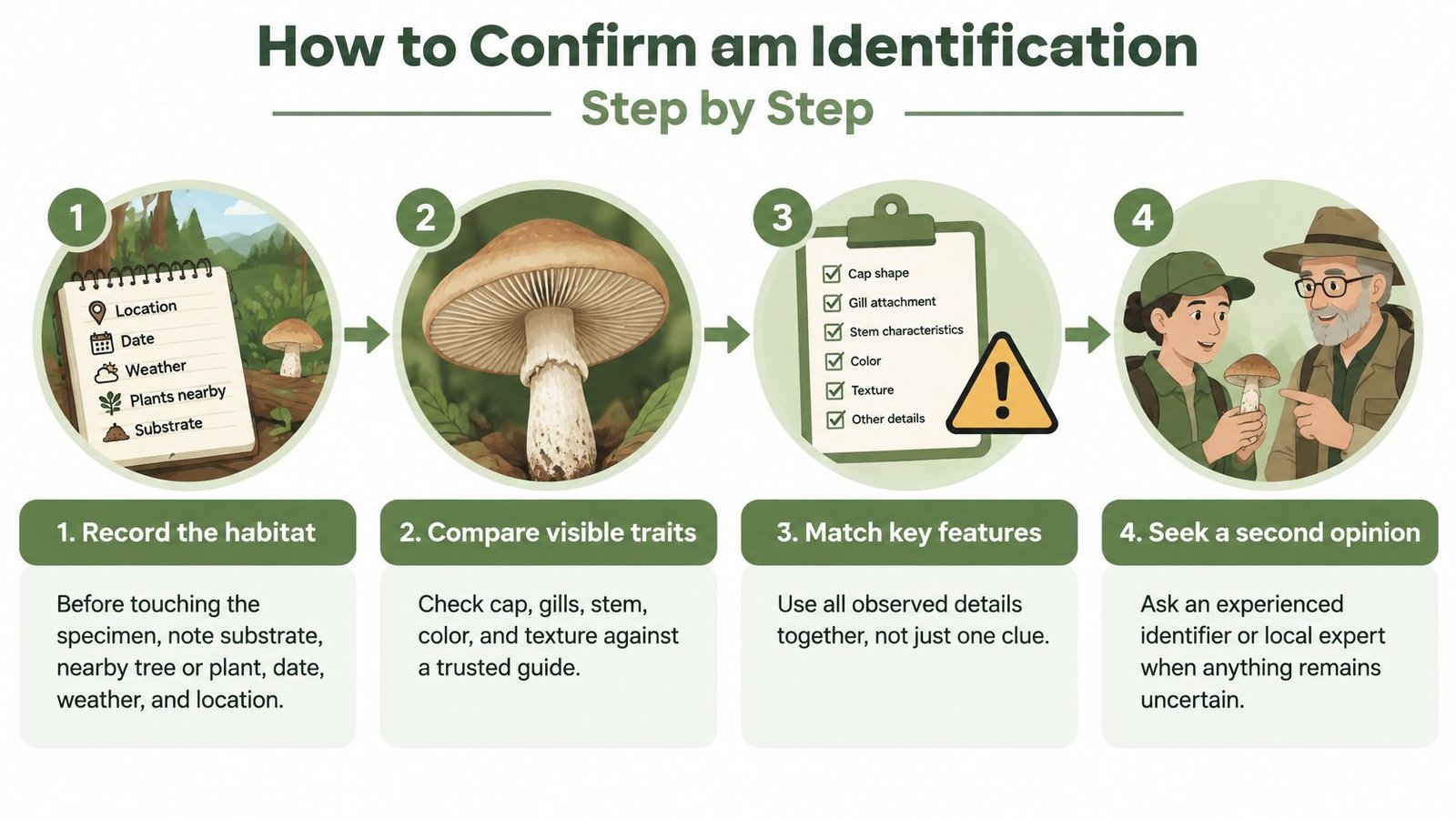
- Record the habitat before you touch anything. Substrate, nearest tree or plant, date, weather, location, and whether the specimen sits on wood, soil, dung or lawn. None of it is recoverable once the mushroom is in your hand, and habitat eliminates candidates faster than any other single record.
- Photograph it in place. Cap, underside, full stem and the point where it meets the substrate. Four frames cover most of it, and they have to be taken before you cut or pull, because attachment is evidence.
- Take a spore print. Lay the cap gills-down on paper that's half white and half dark, cover it, and leave it for a few hours, or overnight if the specimen is dry. Spore colour narrows families, and plenty of keys won't run without it.
- Run the key, then run a second source. Compare against a current regional taxonomic key and at least one independent reference. Two sources agreeing is worth more than one source you trust, and two sources disagreeing is a stop signal rather than a tie to break.
- Stop when a decisive character is missing, contradictory or hidden by age. Very young, faded, decomposing or damaged specimens may lack the characters needed to separate an edible species from a toxic one. That's not permission to lean on the remaining features. It's a reason to leave the mushroom where it is.
- Discard the compromised specimens. Immature, rotting, contaminated or pest-damaged material comes out of the basket entirely, not into a separate bag for later.
The UK government's guidance for safe foraging states the standard without decoration: wild mushrooms should never be eaten unless their identity is known with certainty. Québec's guidance adds the practical corollary, advising foragers to avoid immature, rotting, contaminated or pest-damaged specimens and to work from identification guides appropriate to the region.
An unresolved identification is a reason to walk away, not a reason to decide by appearance. Walking away costs you a mushroom. Deciding by appearance can cost you a liver.
Look-Alike Pairs That Cause Most Poisonings
Most serious poisonings come from a short list of confusions, and in each one a single character separates the two species. Learn the pairs, not just the species.
| Edible Species | Dangerous Look-Alike | Key Difference to Check |
|---|---|---|
| Chanterelle (Cantharellus species) | Jack-o'-lantern (Omphalotus species) | Chanterelle has blunt, forked ridges; jack-o'-lantern has sharp, true gills and grows in dense clusters on wood |
| Button mushroom (Agaricus species) | Destroying angel (Amanita species) | Destroying angel has a volva at the base, often sitting at or below the soil surface, and a stem ring that can collapse or smear away with age |
| Paddy straw (Volvariella volvacea) | Death cap (Amanita phalloides) | Paddy straw grows on straw and decaying plant matter with pink spores; death cap grows with trees and has white spores |
| True morel (Morchella species) | False morel (Gyromitra species) | True morel is hollow from cap tip to stem base; false morel has a wrinkled, brain-like cap and a cottony interior |
Chanterelles carry blunt, forked ridges that run down onto the stem like folds of skin. Jack-o'-lanterns carry sharp, true gills and fruit in dense clusters on buried or decaying wood, often exactly where a chanterelle forager is looking. The cluster is the tell. A single jack-o'-lantern is easy to miss; a dozen sprouting from one piece of buried wood is not. Eating it produces gastrointestinal illness rather than liver failure, which is a mercy and also the reason people repeat the mistake.
When the Dangerous One Is the Plain White One
The button mushroom pair catches experienced cooks, because a young destroying angel is white, smooth and roughly the size of something from a supermarket shelf. Two features separate it, and both hide well. The volva sits at the base, at or under the soil surface, so a specimen pulled instead of dug can arrive in your hand already stripped of its most decisive character. The ring on the stem can collapse or smear away with age and rain. Dig the whole base out before you decide, and check for the volva in the hole as well as on the stem. A supermarket-shaped mushroom you can't fully excavate is a mushroom you can't identify.
Paddy straw grows on straw and decaying plant matter, and its spores are pink. The death cap grows in association with trees, and its spores are white. Spore colour plus habitat settles that pair, and both checks cost almost nothing: read the ground it fruits from before you cut it, and take the print before it goes anywhere near the kitchen.
Cut a morel lengthwise and read the cross-section. A true morel is hollow from the tip of the cap to the base of the stem, in one continuous chamber. False morels have wrinkled, brain-like caps and a cottony, chambered interior. That cross-section is the whole identification, and no amount of cap inspection replaces it.
Four pairs out of dozens, and species ranges shift with latitude, elevation and forest type, so the pair that matters where you forage may not appear here at all. Build your local list from a regional key and add to it as you learn.
If the separating character can't be confirmed on the specimen in front of you, the mushroom goes in the bin, not the pan.
Apps, Books and Experts as Screening Tools
The strongest screening tool you can carry is a book written for your region, because it gives you a key to work through: couplets, habitat notes, seasonal timing and warnings about the pairs that poison people.
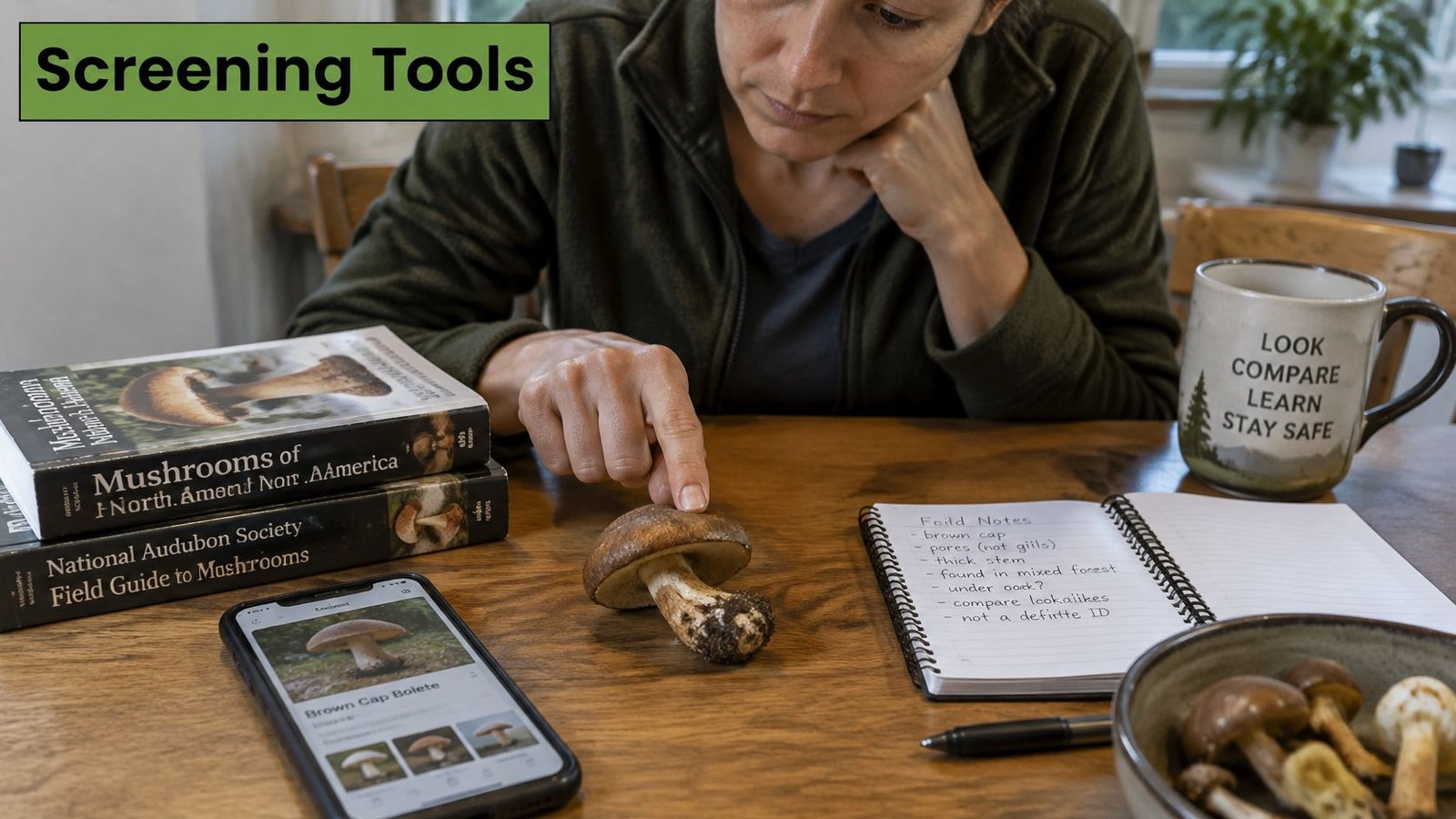
Regional field guides carry that structure because a good one was built from the ground up for a defined area. The revised 2022 edition of Mushrooms of the Pacific Northwest describes and illustrates 493 conspicuous, distinctive and ecologically important species across Oregon, Washington, southern British Columbia, Idaho and western Montana. Inside that range it is a genuine asset. Outside it, the same book becomes a liability, because it cannot warn you about a species it never covered.
An app works as a first pass. A real-world evaluation tested more than 100 photographs covering nearly 60 mushroom species and found that even the best-performing identification tool failed on almost 15% of cases, with no application consistently returning one correct answer, as reported in npj Science of Food. Identification tools tend to perform well on clean, curated photographs and degrade on exactly what a forager hands them: blurry images, immature specimens, and species outside their training data. A mushroom pickers guide that lists species without explaining those limits is selling confidence it can't back.
The rule I'd write on the lid of every basket: AI-assisted, never AI-only.
If you want to see how a careful identifier talks through a specimen before reaching for a phone, this walkthrough is worth the time.
The stop conditions are the same for every tool: poor image quality, a species outside your region, a specimen too young for the key to handle, or any disagreement between two sources. Each ends the process the same way. You contact a poison center or a qualified local mycologist, and the mushroom stays out of the kitchen. Keep those contacts somewhere you can reach fast, because the same numbers you would call to break a tie in the field are the ones you will call if symptoms start hours after a meal. Identification is a workflow that runs from the first photograph to the morning after, and every screening tool you carry is one step in it.
Harvesting, Handling and Storing Your Haul
Everything the identification work bought can still be lost between the knife and the fridge. Careless handling can't turn a safe mushroom poisonous. It can still spoil the batch or hide the one specimen that should never have been picked. Six steps, each with a reason attached.
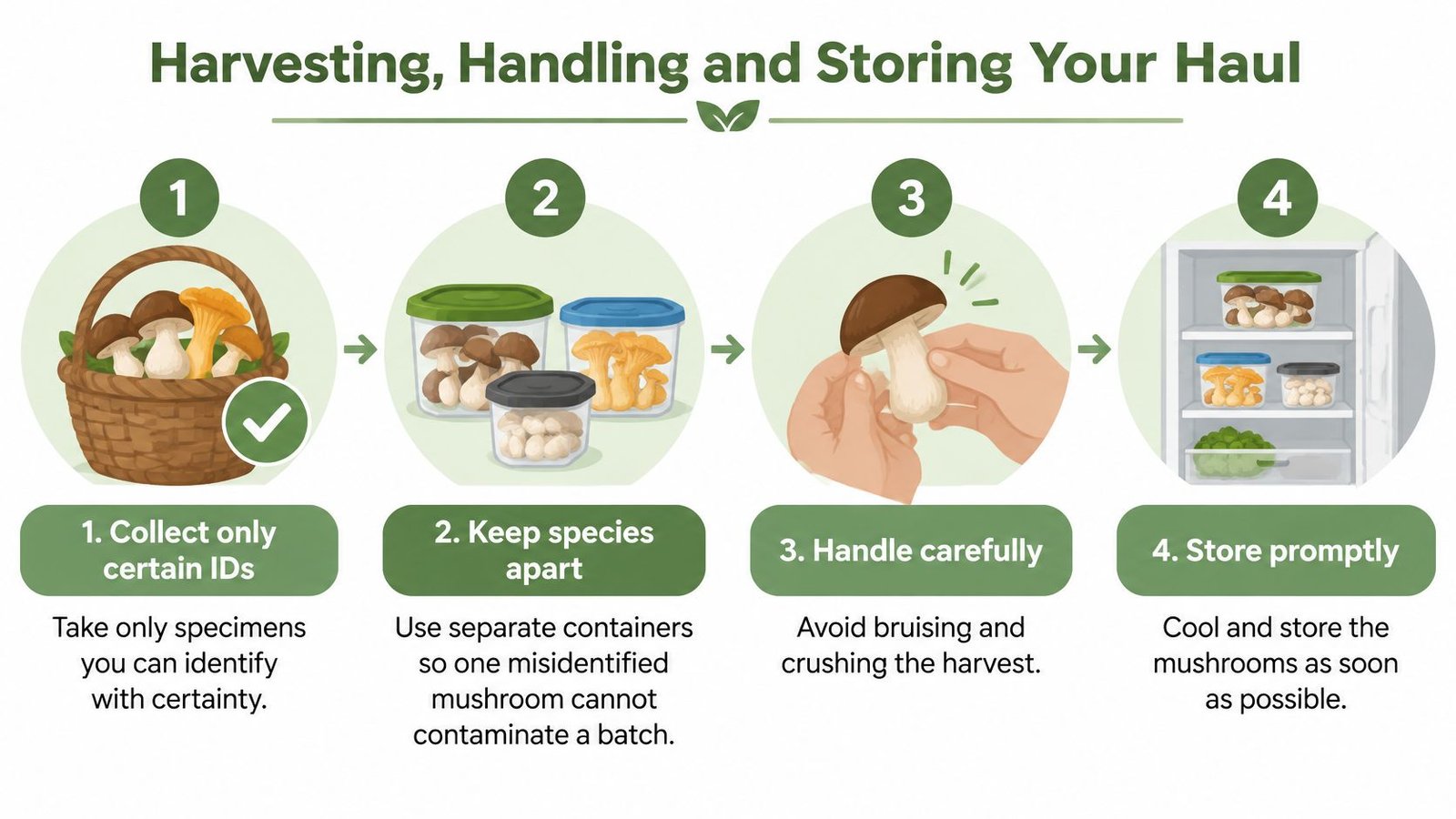
- Collect only what you can identify with certainty. A basket half full of confirmed species beats a basket full of maybes, and the maybes eat the attention you need for the specimens you're sure of.
- Keep species in separate containers. One paper bag per species means a single misidentified mushroom can't season the whole batch, and a wet species can't turn a dry one to slime on the drive home.
- Avoid contaminated ground. Roadside verges, treated lawns, sprayed orchards, and anything near a septic system or chemical storage all count. Fungi take up what's in the substrate, and cooking doesn't remove heavy metals or pesticides.
- Use breathable bags. Paper or mesh lets moisture escape. Sealed plastic traps condensation instead, and a warm car does the rest.
- Refrigerate promptly. Get the harvest into the fridge within a couple of hours of leaving the woods and plan to use it within days, not weeks.
- Cook it thoroughly. Heat destroys some mushroom toxins and leaves amatoxins untouched, so cooking is a safety step rather than a substitute for identification. Raw wild mushrooms aren't worth the risk.
Personal Use, Sale and Supply
The moment money or a commercial kitchen enters the picture, the rules stop being advice and become regulation. The German Federal Institute for Risk Assessment's warning on deadly mushroom mix-ups recommends thorough cooking for wild mushrooms. Rules for selling or serving wild mushrooms vary by jurisdiction, and they typically go further: the mushrooms must come from an approved source and pass individual inspection by a qualified identification expert.
A home mistake affects one dinner. A restaurant batch multiplies a single error across dozens of plates, and the person who eats it never handled the mushroom. Amatoxin symptoms can also take hours to appear, so a quiet evening after a served meal proves nothing about whether the identification was right.
If you plan to share, sell or serve a harvest, check the rules where you forage and arrange expert verification before the first delivery. I'd treat anything headed for someone else's plate as a separate job with its own checklist, because the standard there is stricter than anything you'd set for yourself.
What to Do If Symptoms Start Hours Later
The most dangerous mushroom in the basket is the one that produces a mild stomach upset and then lets you go to bed. Amatoxin poisoning follows a pattern: nausea, vomiting, cramps and diarrhoea some hours after the meal, then a stretch where the patient feels noticeably better, then liver injury that can escalate fast. That apparent improvement is the trap, and it's why "I felt fine by midnight" isn't evidence of anything.
| Timing | What to Expect | Action |
|---|---|---|
| Any time after a suspected meal | Vomiting, diarrhoea or cramps that may seem ordinary | Call poison control or emergency services now, even if the mushroom seemed correctly identified |
| With the leftovers | Uncooked remnants, cleaning scraps and photographs | Keep sealed and refrigerated, and bring them to clinicians or experts |
| Throughout | Home remedies or induced vomiting | Avoid unless a poison-control expert directs it |
Write down who ate what, how much, and at what time, and keep the notes with the specimens. Memory gets unreliable in an emergency department at 2 a.m., and a timeline is one of the few pieces of information that changes how quickly a clinician acts. Photographs of the intact mushrooms, the trimmed stems and the cooking scraps are worth more than a description, because remnants support expert or laboratory identification.
A correct-looking identification does not rule out poisoning.
Skip the home remedies and skip induced vomiting unless a poison-control expert tells you otherwise. Neither removes amatoxins, and both can delay the treatment that does help. The point of the table isn't to make you afraid of the woods. It's to move the decision forward, from "let's see how I feel in the morning" to a phone call made while the meal is still a possibility rather than a memory.
The answer to delayed-onset risk isn't to stop foraging. It's to make the timeline part of the trip: the numbers already saved, the leftovers already kept, the photographs already taken, and the rule already settled that a suspected exposure gets a call, not a wait.
Mushrooms For Sale is a directory and community resource for everything mushroom-related, from functional suppliers and growers to equipment, dispensaries and foraging-safety articles. If this guide has you rebuilding your kit or looking for a local grower, supply shop or therapist, you can search by category and location, compare what's nearby or online, and reach out directly. Start at Mushrooms For Sale and see who's listed near you.