The most repeated advice about reishi tea is that it works like any other herbal brew: a bag or a spoonful of powder into hot water, five minutes, drink. Ganoderma lucidum doesn't cooperate with that. The fruiting body is corky, fibrous and woody, and a brief steep barely penetrates it, which is why the traditional preparation is a simmered decoction rather than a quick infusion.
The second piece of popular advice is worse: that a cup delivers a dose of reishi. It doesn't deliver one anybody can quantify. What you can do is brew something repeatable, using a weighed amount of dried mushroom, a measured volume of water, a set simmer time and a note of what you did, so the next batch matches the last.
That's the frame for everything below. A cup of reishi tea is a culinary decoction of unknown strength. It belongs next to your kettle, not next to your prescriptions.
Table of Contents
- Reishi Tea Recipe Card at a Glance
- Choosing Slices, Powder or Extract for Tea
- Who Should Skip Reishi Tea and When to Stop
- How to Brew Reishi Tea Step by Step
- Fixing Bitter, Weak or Cloudy Tea
- Batch Log, Storage and Your First Cup
Reishi Tea Recipe Card at a Glance
Here's the entire batch on one card. Copy it, tape it inside a cupboard door, and write your own numbers on it as you go.
Reishi tea batch at a glance
| Element | Amount | Why It Matters |
|---|---|---|
| Dried Ganoderma lucidum slices | 1–2 g per batch | Weigh them; spoons are unreliable |
| Water | 250–500 mL | Starting volume sets final strength |
| Simmer time | 60–120 minutes | Woody tissue needs a long extraction |
| Heat | Gentle simmer, no rolling boil | Hard boiling concentrates unpredictably and bitters the tea |
| Extraction cycles | 2 | Simmer the solids again with fresh water |
| Serving size | Not established | No medically established dose exists |
The batch figures above come from published reishi extraction work, and every one of them is a kitchen measurement rather than a therapeutic one. You weigh the slices because reishi is dense and uneven, so two spoons of broken pieces can differ in weight by a wide margin. You measure the water before it goes on the heat because the starting volume is what sets the strength of the finished batch, and an uncovered simmer that boils off half the pot leaves you with something far more concentrated than you planned.
Powder doesn't fix the measuring problem. Powders pack differently, clump, and vary in particle size, so a tablespoon tells you nothing reliable about how much mushroom is in the pot. Grams tell you something.
What the card can and can't give you: a repeatable, palatable decoction you can log and adjust. It cannot tell you how much of any compound ends up in the cup.
The MSD Manuals consumer entry on reishi draws that line clearly. The human evidence concerns standardized extracts rather than homemade decoctions, and the studies themselves are often small, short and inconsistent. That's why the card prints grams and milliliters instead of a health claim, and why it doesn't pretend a serving size has been agreed on.
If reishi is your entry point into this category, our beginner's guide to functional mushrooms covers how the other common species are used and sold. What follows here moves through form, method, troubleshooting and safety, in the order you'll need them.
Choosing Slices, Powder or Extract for Tea
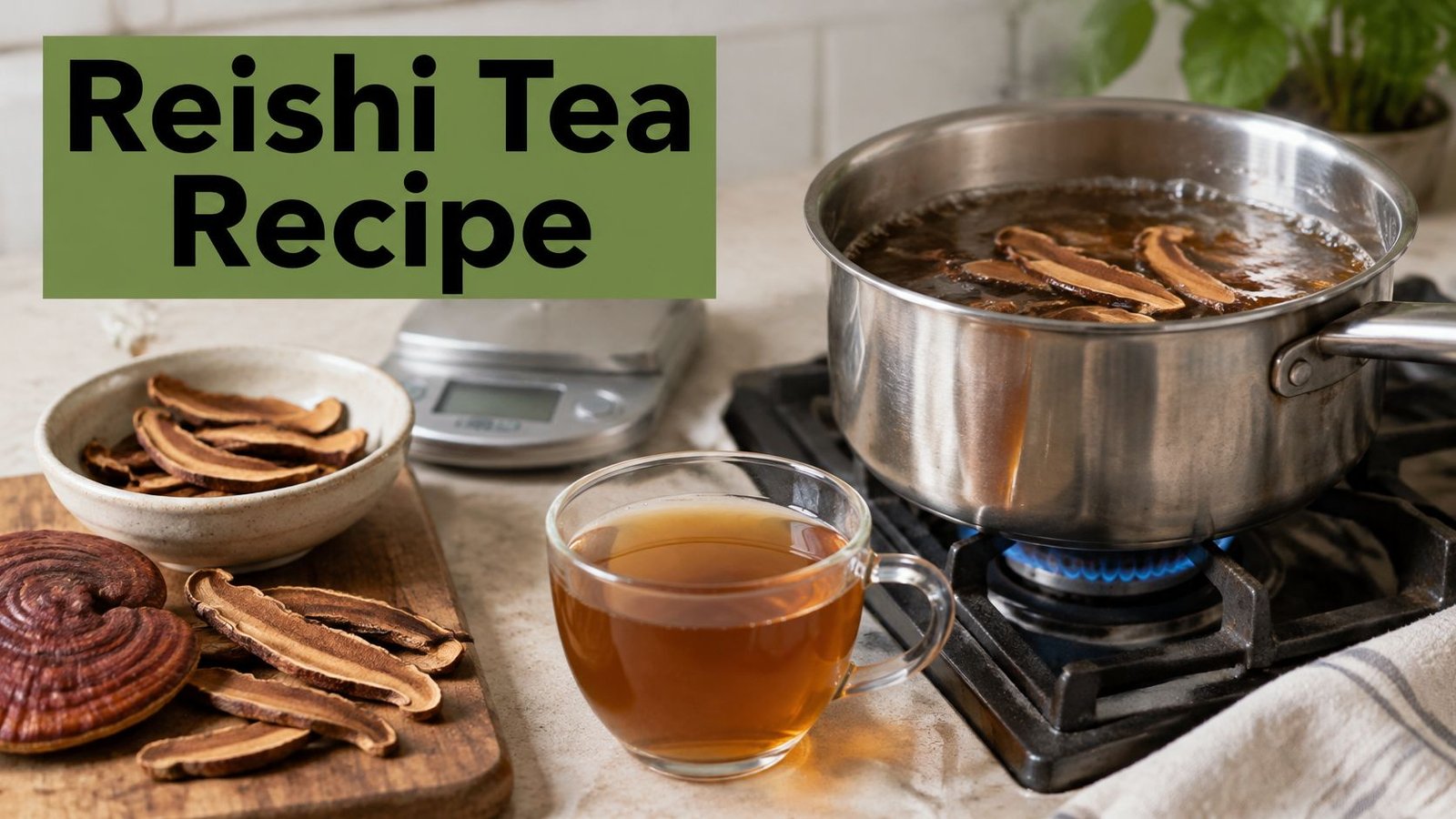
For a simmered tea, buy dried slices of the fruiting body. That's the form the recipe card assumes, and it's the form the tradition is built on: reishi tea is traditionally a hot-water decoction of dried slices, a method that reflects the mushroom's tough, woody texture, as MedlinePlus on reishi describes it.
Three forms turn up on shelves, and they look more interchangeable than they are. The photo below shows what each one looks like next to a scale.
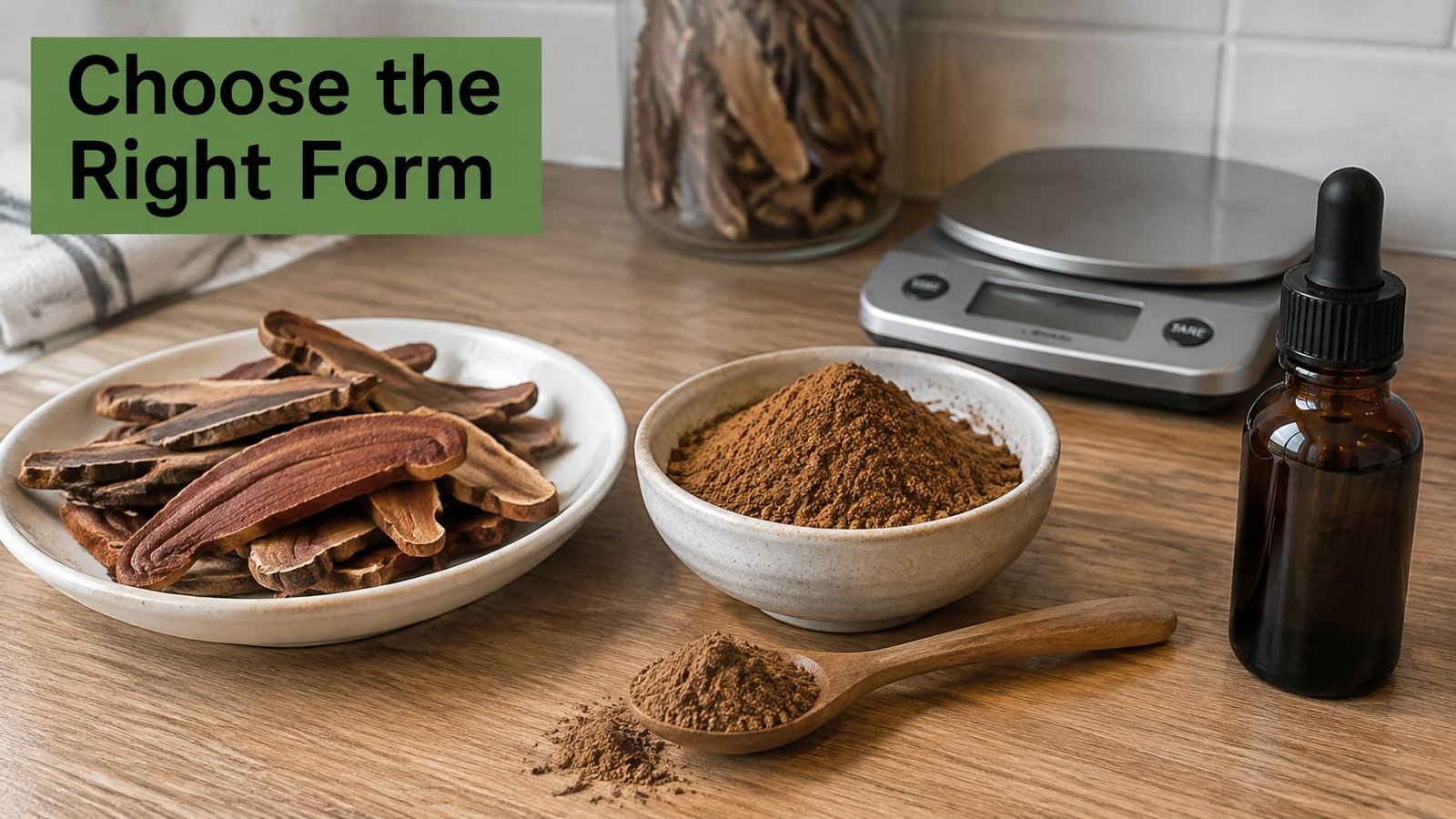
Reishi forms compared for home tea
| Form | How It Is Prepared | What Can Be Measured | Fit for Home Tea |
|---|---|---|---|
| Dried slices | Simmered 60–120 minutes | Dry weight, 1–2 g per batch | Best fit |
| Powder | Steeped or simmered briefly; clouds the water and settles | Weight only, no reliable potency | Poor gram-for-gram match |
| Standardized extract | Dissolved per label | Labelled milligram content | Not a substitute for a decoction |
Slices give you the one thing a home brewer can control: a dry weight you can repeat. Powder is the awkward middle option. It looks like a stronger buy, but a gram of fine powder and a gram of woody slice don't behave the same way in hot water, so swapping one for the other while keeping the same number changes the brew. If a recipe written for slices gets made with powder, expect a cloudier, heavier cup, and expect the strength to shift.
Extracts sit at the other extreme. They're sold in milligrams and labelled to a manufacturer's own specification, which describes that company's process rather than a shared standard. Two bottles both marked "reishi extract" can contain very different material.
The research literature doesn't hand you a household number either. Human studies have tested very different doses and durations, largely because the products under study differed so much in extraction method and starting material. Those are research quantities measured on standardized preparations, not serving suggestions for a kettle. MedlinePlus states that scientific evidence is insufficient to define an appropriate general dose, which is the most useful sentence in the literature for anyone standing at a stove.
The buying rule is short. Buy slices for a decoction, read the label carefully if you're using an extract, and keep supplement doses off the teapot entirely. If you'd rather collect than buy, read our foraging safety tips first, because reishi has lookalikes and the consequences reach beyond a disappointing cup.
Who Should Skip Reishi Tea and When to Stop
Before the kettle, the screen. Reishi is generally well tolerated, but a handful of situations call for a clinician's sign-off before your first cup, not after a week of drinking it.
- Blood thinners and antiplatelets: if you take warfarin, aspirin or another antithrombotic medicine, ask first. The Merck Manual's professional monograph on reishi reports potential increased bleeding when reishi is combined with these medicines.
- Blood pressure and blood sugar medication: effects may add up, so your prescriber should know what you're drinking.
- Scheduled surgery: raise it with your surgeon, because bleeding risk matters in an operating room.
- Pregnancy and breastfeeding: safety information is insufficient, so this is a skip unless a clinician says otherwise.
- Liver disease or a history of liver problems: don't start without medical advice.
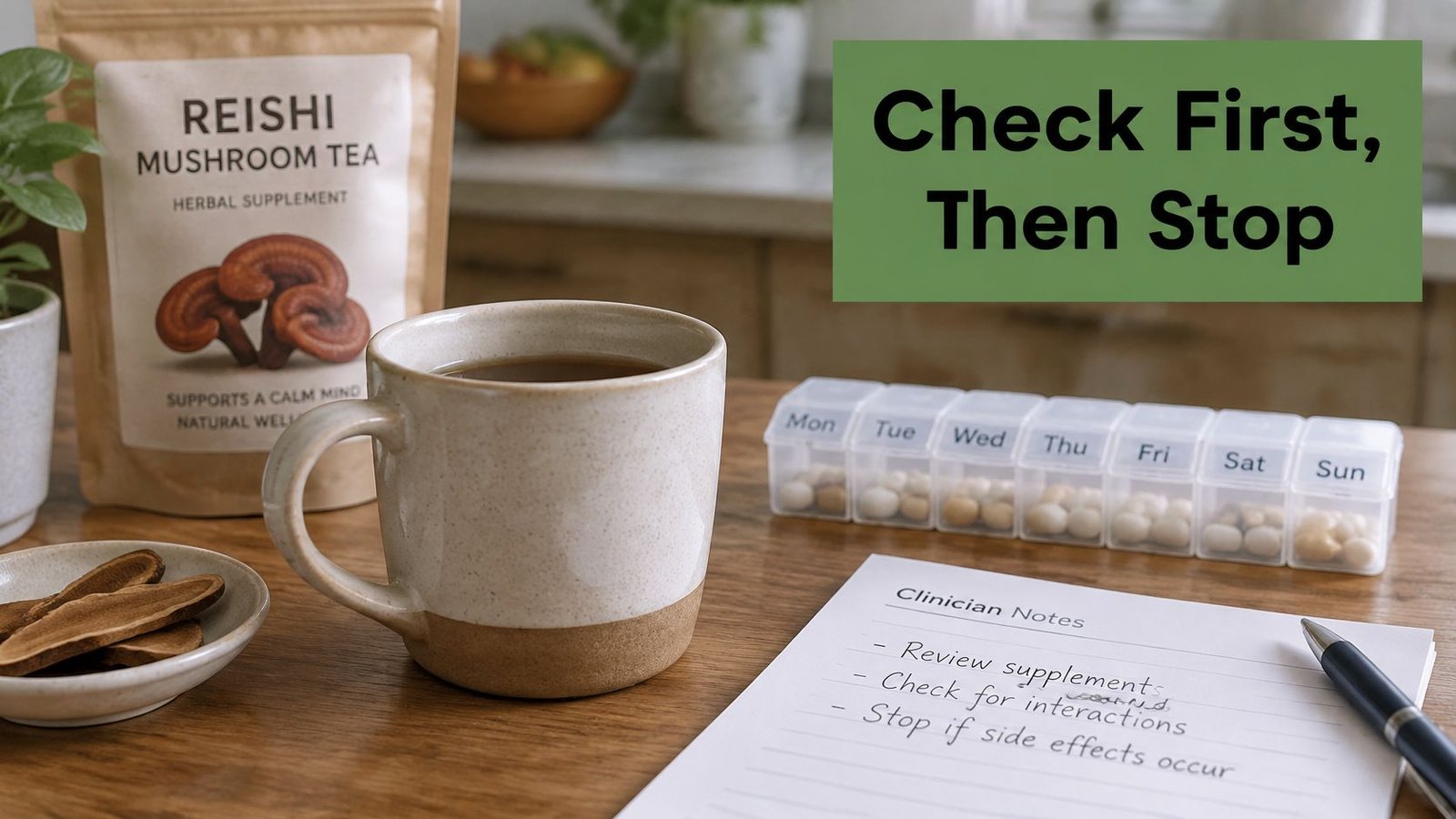
Rare cases of suspected reishi-associated liver injury have been reported across several countries, ranging from abnormal liver enzymes to severe hepatitis. Causality is often uncertain, and other ingredients or medicines may be involved, which is why this reads as a caution rather than a ban. Short-term trials haven't consistently shown liver-enzyme abnormalities either. Rare-event risk plus uncertain product composition still justifies clear precautions, especially for a drink people assume is mild.
Know the symptoms that mean stop, not slow down:
- Yellowing of the skin or eyes
- Dark urine
- Unusual itching
- Persistent nausea
- Marked fatigue
- Unusual bleeding or bruising
Stop the tea and seek medical care rather than pushing through a week of symptoms to see whether they settle on their own. How long a person can reasonably keep drinking it is a question for a clinician who knows your history, not for a recipe card.
The line that matters: a cup of reishi tea is not a treatment for any condition, and it doesn't replace a diagnosis, a prescription or a follow-up appointment.
Tea is a ritual, not a regimen. If you're building a routine around mushrooms, our guide to mushrooms and everyday wellness keeps the rest of it in proportion.
How to Brew Reishi Tea Step by Step
A good reishi brew rewards patience more than precision. Each move below has a reason attached, and the reason is what lets you correct the batch when something drifts.
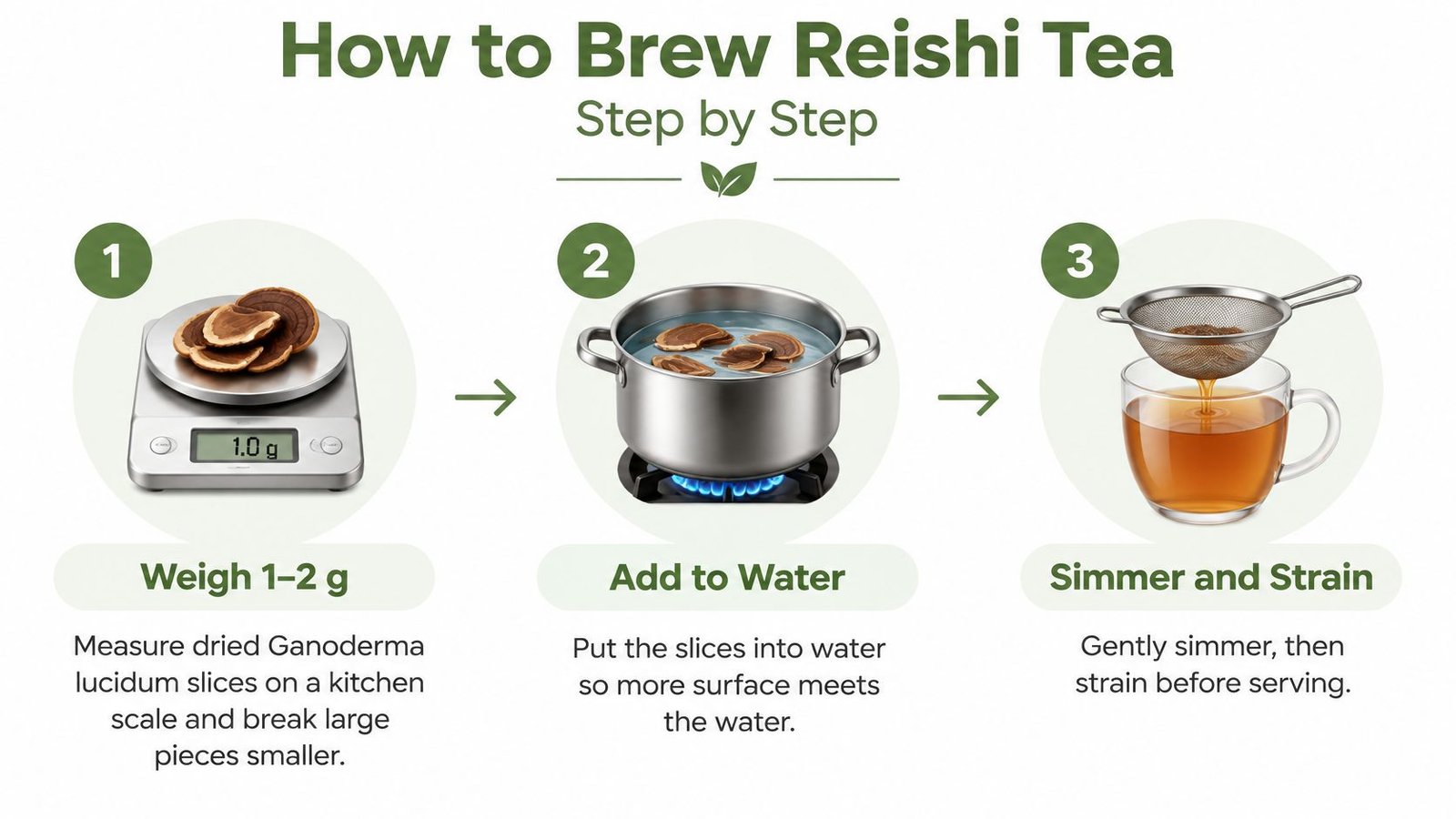
- Weigh 1–2 g of dried slices. A kitchen scale that reads to a gram is enough, and breaking the larger pieces smaller with your hands or a knife exposes more tissue to the water.
- Add them to the pot with the water you measured. Starting volume, not final volume, is what sets strength, so don't top up out of habit.
- Cover the pot and bring it to a gentle simmer. A rolling boil concentrates the liquid unpredictably and can push the brew toward harsh bitterness.
- Hold the simmer for 60–120 minutes with the lid on. A published home-decoction protocol pairs 1–2 g dried material with 250–500 mL water and a 60–120 minute gentle simmer, according to extraction research on reishi. The same work cites a research benchmark of 20 volumes of water, a 95°C bath for 6 hours and three extraction cycles, which is why a five-minute steep under-extracts tough fungal tissue.
- Strain through fine mesh into a clean jug while it's still warm. Warm liquid passes more cleanly than cold, and a clean jug limits what the batch picks up afterward.
- Return the solids to the pot with fresh water and simmer again. A second extraction recovers more from tissue that's already softened.
- Keep the second run separate or combine it, and record the grams, starting volume and minutes. Strength belongs in grams of dried mushroom and final volume, not in teaspoons of powder.
- Cool the liquid before drinking, and refrigerate whatever you don't finish. Cooling first makes the bitterness easier to judge and gives you a chance to smell the batch before it goes in you.
A kitchen pot can't match a laboratory, and it doesn't need to. Hot water pulls polysaccharides out of reishi effectively, which is why water is the right solvent for this tea. Triterpenoids come across less efficiently in plain water, and the optimized lab processes that recover more of them rely on ethanol-based solvents and equipment no home setup has. Longer simmering won't close that gap. The cup in front of you is a culinary decoction of unknown strength, and that's the honest frame for it.
What the Finished Brew Should Look Like
Expect a light amber to dark brown liquid with a woody, earthy aroma. Darker usually means more material or more reduction rather than more potency. Sourness, a sharp off smell or visible fuzz sends the whole batch down the drain.
If you'd rather watch the sequence once before you start, this walkthrough covers the same ground.
Fixing Bitter, Weak or Cloudy Tea
Bitterness is the complaint you're most likely to meet, and it almost always traces back to heat or evaporation. Pull the pot down to a bare simmer and top it up to the volume you planned, and the next cup softens.
Taste and clarity problems, causes and fixes
| Symptom | Likely Cause | Fix |
|---|---|---|
| Bitter taste | Rolling boil or long reduction | Lower to a gentle simmer and add water to the planned volume |
| Weak, pale tea | Too little material or too much water | Cut slices smaller and use the lower end of the water range |
| Cloudy liquid | Fine particles pass the strainer | Double strain through fine mesh or cloth; still check the smell |
| Flat, thin flavour | Under-extraction on first pass | Run a second extraction on the solids |
| Syrupy, over-strong | Evaporation during long simmer | Top up water to the planned volume next time |
Cloudiness is a straining problem, not a safety verdict on its own. Pour the batch through a second layer of fine mesh or a piece of clean cloth, then run the smell test from the brewing section. A clear, sour liquid is worse news than a hazy, clean-smelling one.
A flat, thin cup after one pass isn't a failed recipe. It's a signal that the solids still have something to give, which is exactly why the second extraction sits on the card.
Two of these fixes change the batch in front of you, and the rest are notes for next time. Change one variable per batch. If you cut the water and shorten the simmer in the same attempt, you learn nothing about which one worked.
Batch Log, Storage and Your First Cup
Write the batch down while the pot is still on the stove. Memory blurs the difference between a 90-minute simmer and a two-hour one, and that difference is the entire reason the log exists. The log works like a lab notebook for a kitchen that has no lab: the written record is what separates a repeatable batch from a lucky one.
What the Log Needs to Capture
- Identity: the species and the form you bought, so you can tell slices from powder when you reorder.
- Dry weight: grams of dried mushroom, weighed on a scale. A handful of slices and a handful of powder are different masses, and grams are the only honest unit.
- Water volume: the starting volume, before evaporation changes it.
- Time and cycles: how many minutes at a simmer and how many extractions you ran.
- Date and storage: the day it was made and how long the jug sat in the fridge.
Five lines per batch is the whole routine. When a cup disappoints, those lines give you one variable to change at a time instead of a guess.
Spoilage follows simple rules. Discard the batch if it develops a sour odor, gas, mold or unexplained turbidity. Refrigerate the liquid promptly, label the jug with the date, and don't stretch a batch past the point where it smells right.
Cold storage slows spoilage. It does not stop it.
The subtler pitfall is treating the cup as a standardized medicinal extract. Hot water is comparatively suitable for preserving and extracting polysaccharides, but reviews describe the method as time-consuming and relatively low-yield for some constituents, particularly triterpenes, as a peer-reviewed review on reishi preparation sets out. A tea brewed from 1 g of slices can't be assumed equivalent to 1 g of concentrated extract or to a labeled polysaccharide dose.
Duration deserves its own line. The MedlinePlus entry on reishi states that an appropriate oral dose has not been established, reports that powdered reishi may be unsafe when taken for more than one month, and notes that extract products have only been considered possibly safe for up to one year. Reported adverse effects include gastrointestinal upset, diarrhea or constipation, dizziness, dry mouth, nosebleed and skin irritation.
Consistency and tolerability are the only benchmarks you can honestly apply at home. Extraction percentages and therapeutic success rates belong to products that were measured in a lab, not to a pot on your stove.
Before Your First Cup
Confirm that none of the screening conditions applies, or talk to a clinician before you brew. Buy dried slices whose identity you can verify rather than an unlabelled bag of fragments. Weigh the first batch instead of estimating it, and start with a small serving to see how you respond. Treat the card as a batch recipe rather than a dose, and stop at once for any warning symptom.
Brew one test batch this week. Note the grams, the volume, the minutes and how the cup tasted, and repeat it only if the tea suits you and your health situation allows it.
Mushrooms For Sale is a directory and community resource for mushroom businesses, products and education, where functional mushroom suppliers, online retailers of powders, teas and tinctures, and cultivation equipment sit in one searchable place instead of scattered across a dozen tabs. If this guide has you weighing slices and keeping notes, that's the same habit that makes choosing a supplier easier. Visit Mushrooms For Sale to browse listings by category and location, and to read the growing and foraging guides that go with them.