The mushrooms are already in the bag. You found a good flush on a damp slope, filled a plastic grocery bag because the basket stayed in the car, and by the time you're home the caps are slick, the stems are soft, and the one specimen you wanted to key out has collapsed into something that smells like wet leaves and looks like nothing in particular.
Nothing changed species on the drive. The bag held the moisture the mushrooms were still breathing out, and four hours of that is enough to ruin the details you need.
A mushroom hunting basket fixes that specific failure, but not through tradition and not through charm. It fixes it through airflow, rigidity and separation, and every basket does those three things to a different degree. That's the yardstick I'd use in a shop, well before appearance.
Table of Contents
- Why the Basket Matters More Than a Bag
- Choosing Capacity for Your Type of Outing
- Materials and Construction Compared
- Keeping Specimens Separate Inside the Basket
- Carrying Comfort and Field Use on the Trail
- What a Basket Does for Sustainable Foraging
- Choose Your Basket Before the Next Outing
Why the Basket Matters More Than a Bag
A damp slope, a good flush of chanterelles, one plastic bag. Four hours later the bag is warm inside, the caps are sweating, and the specimens at the bottom have lost the shape you needed to check against a key.
Three functions prevent that, and they become the criteria for everything else here.
- Airflow. Freshly cut mushrooms keep respiring. Seal them in and the water they release condenses on the inside of the bag and comes straight back onto the flesh. An open weave lets heat and vapour leave, so caps stay dry enough to handle, photograph and cut.
- Rigidity. A firm wall and base stop a heavy bolete from pressing down on a fragile chanterelle underneath. That isn't cosmetic. Bruised flesh discolours, tears, and bruising happens to be one of the features you're reading to make an identification.
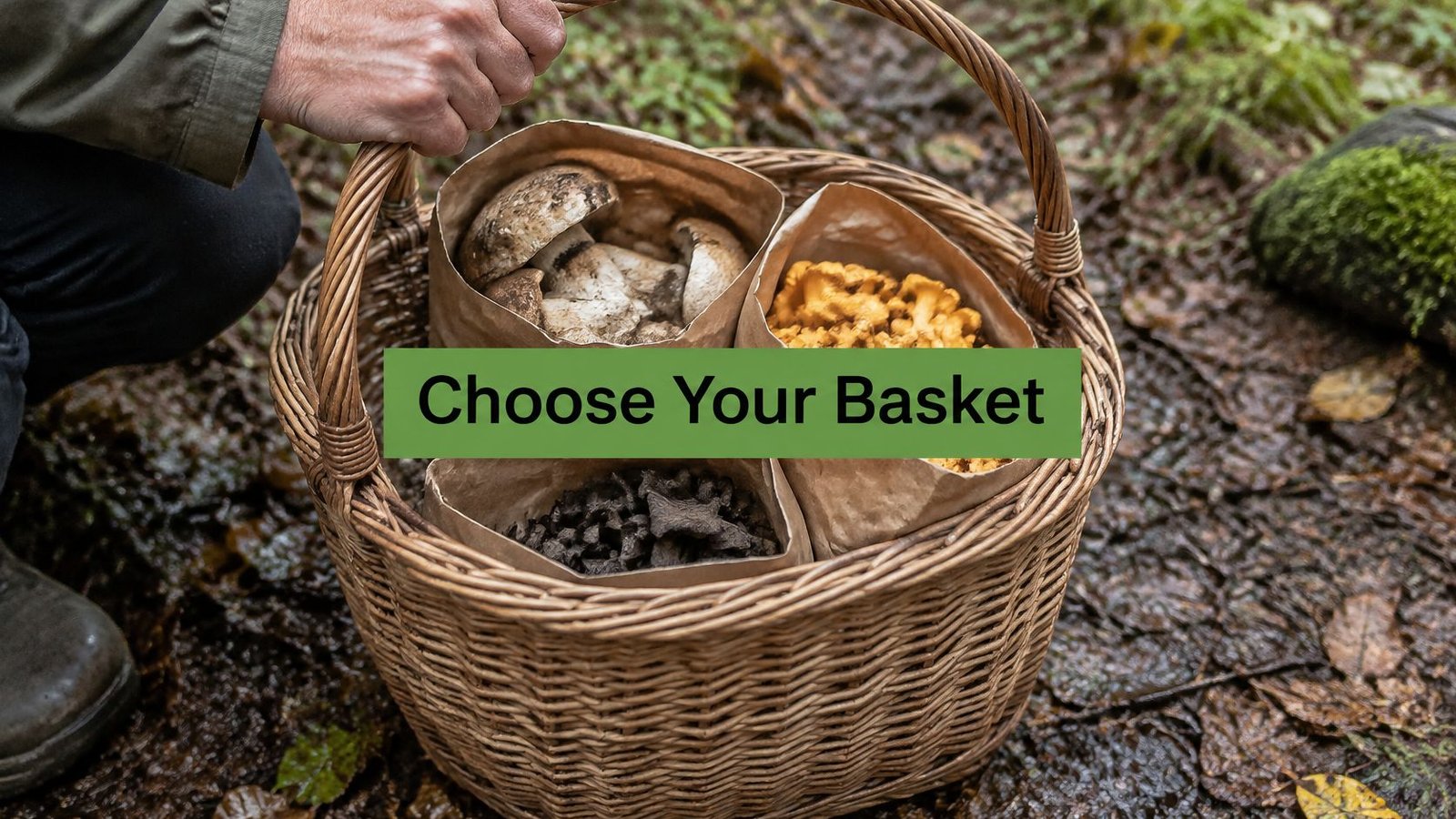
- Separation. A basket has room for paper bags inside it, one per species or one per site. Nothing touches anything else, soil stays where it was picked, and you can lift a single specimen without unpacking the load.
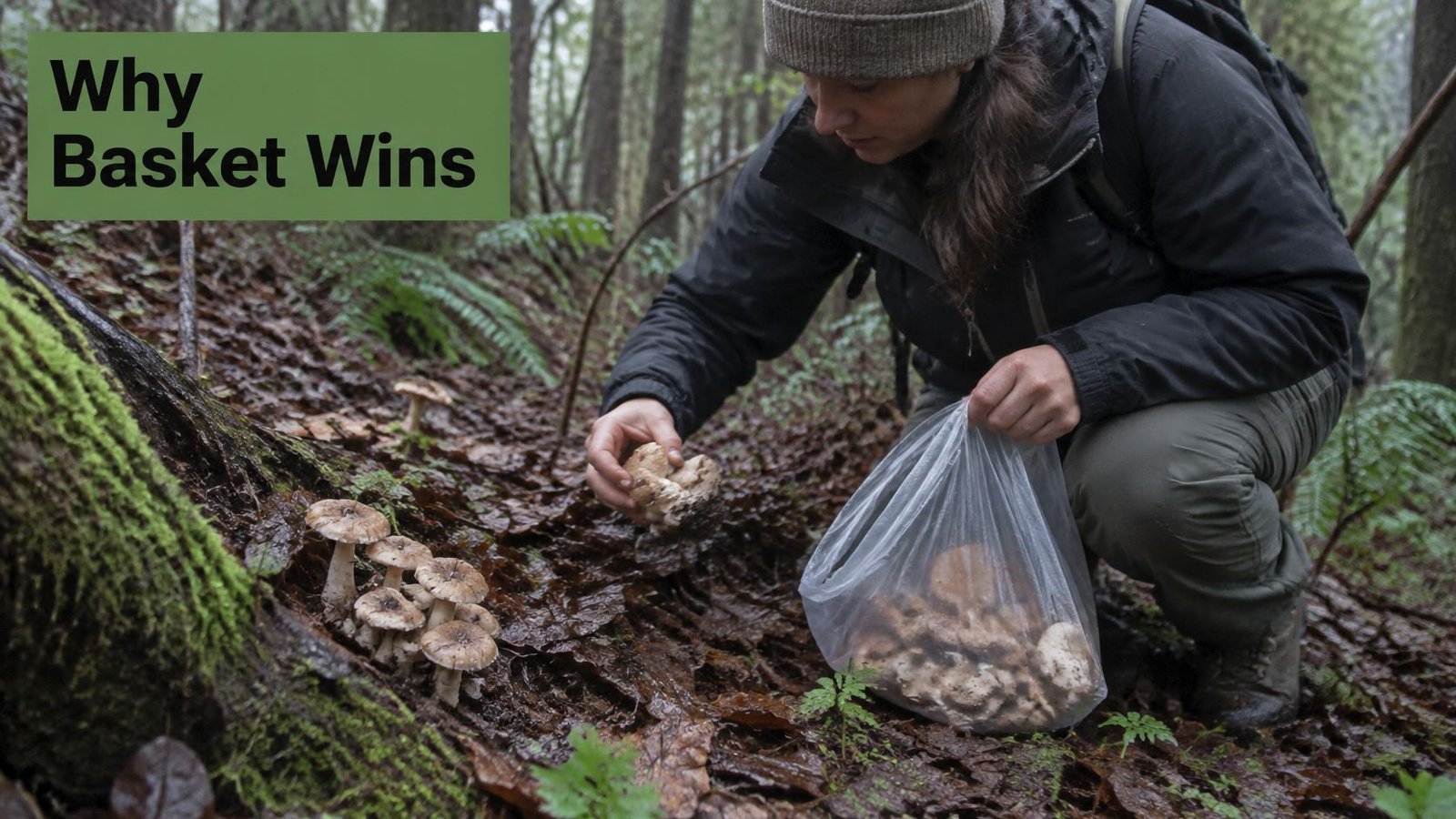
The fourth argument gets repeated most and evidenced least: spore dispersal. A 2025 survey of harvesters in the Mid-Atlantic United States, published in Economic Botany, notes that porous containers can let spores escape during transport and disperse through the collection area, which is the mechanism behind the old advice (Springer, Economic Botany).
That same survey also keeps the basket in proportion. Of 803 respondents, 472 (59%) reported using a basket at least sometimes, while 574 of 800 (72%) said the same about a mesh bag. A basket is a common choice, not a demonstrated superior one, and 616 of 803 (77%) also kept seasonal harvest limits at least sometimes. The people carrying baskets tend to be the people already doing several other things carefully.
What decides it: if a basket doesn't beat a plastic bag on at least two of the three, airflow, rigidity or separation, it isn't a mushroom hunting basket. It's a prop.
Choosing Capacity for Your Type of Outing
Volume on a product page tells you very little on its own. Load, depth and what you can fit inside matter more.
| Outing | Typical Load | Usable Capacity | Packing Note |
|---|---|---|---|
| Half-day, one site | 1-2 kg | 10-15 L | Room for paper bags in a single layer |
| Full day, several species | 3-5 kg | 20-25 L | Two layers maximum with a divider |
| Multi-day or group collecting | 8-12 kg across the party | 30 L, or split across two baskets | Keep each species in its own basket section |
| Large or brittle caps | 2-4 kg | 12-15 L | Shallow load, heavier specimens at the bottom |
A half-day basket around 12 litres holds three or four quart paper bags side by side without stacking. That's the shape you want for a single site where you'll pick one or two species and walk out by lunchtime.
The full-day row is where shoppers often underbuy. 20 to 25 litres gives you room for five or six bags, and a rigid divider lets you run a second shallow layer without the upper weight landing on what's below. A deep 30-litre basket used as one open bin is worse than a shallow 20-litre basket with structure, because everything settles to the bottom and presses.
What usable capacity actually means
Paper bags, dividers and a handle that intrudes into the load all eat space. Tapered sides shrink the floor area where the flat-bottomed bags sit, and deep walls mean you can't see the bottom layer without emptying the basket. A wide, shallow basket with a flat base will carry more usable load than a taller one of the same stated volume.
The two-layer rule holds across every size. Past two layers you're stacking weight on specimens, and the ones at the bottom arrive flattened.
Load test before you buy: pack your own paper bags at home, fill to the load you actually plan to bring back, and carry the basket for twenty minutes. Weight you notice after five minutes is weight you'll resent after three hours.
Every extra litre adds empty weight, and a full-day basket should still be something you'd carry for a whole afternoon without thinking about it. For brittle or oversized caps, drop to the 12 to 15 litre band and keep the load shallow.
Materials and Construction Compared
Material drives all three criteria at once, so it's worth comparing them side by side rather than arguing willow against plastic in the abstract.
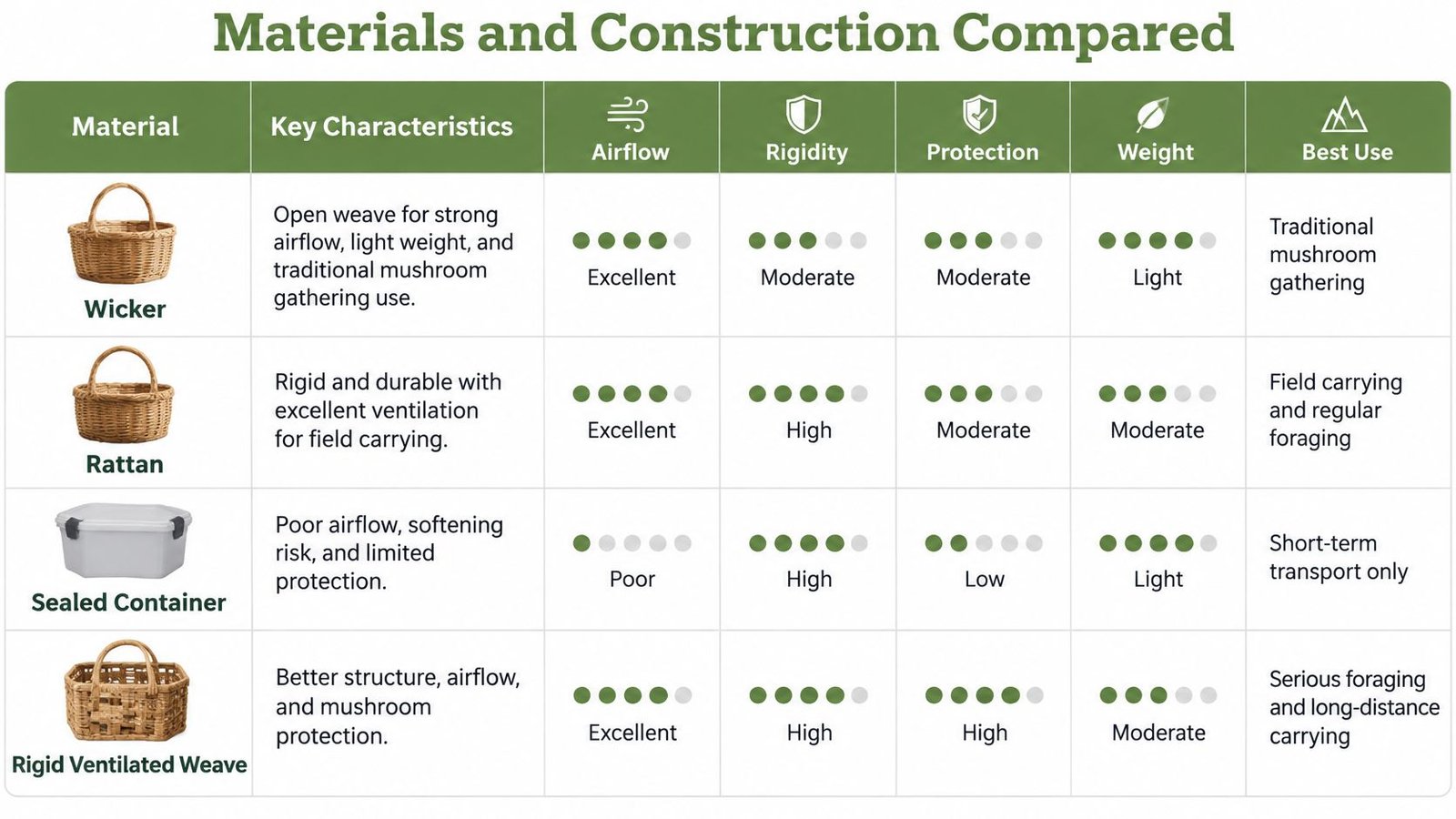
| Material | Airflow | Rigidity and Protection | Weight | Best Use |
|---|---|---|---|---|
| Wicker (willow) | High | Good with a rigid frame | Medium | Traditional foraging in dry conditions |
| Rattan or cane | High | Good, durable | Medium | Multi-season use with heavier loads |
| Mesh or slatted plastic | High | Low to medium, flexes under load | Light | Short trips and drying specimens |
| Vented plastic tub | Medium | High | Medium to high | Wet weather and bulk harvests |
| Sealed plastic bag | Low | Low | Very light | Not recommended for specimens |
Wicker is the reference point for a reason. The open weave gives strong airflow, and a properly built willow basket has a stiff rim and base, so the walls hold their shape when you set it down on uneven ground. The weakness is weather: willow takes on water, and a soaked basket transfers that moisture inward.
Rattan or cane keeps the ventilation and adds durability. It's the better choice if you're out most weeks across a season and carrying heavier loads, and it resists the knocks that split softer weaves.
Mesh or slatted plastic wins on weight and packs flat, but it flexes. Load it with three kilos of bolete and the sides bow inward, which is exactly the pressure the basket was supposed to prevent. Fine for short trips in dry weather, and useful for spreading specimens out to dry at home.
Vented plastic tubs protect best and clean easiest, which matters when you've been handling something toxic and want to wash the container afterwards. They also hold heat, and on a warm day a tub with a few vents is closer to a bag than to a basket.
A sealed plastic bag is the weakest option in every column that matters. It traps moisture, and soft mushrooms deteriorate in it faster than anywhere else (mushroom hunting practices).
Construction details that matter
- A wide, rigid base that sits flat when you put the basket down, so the load doesn't tip into one corner.
- A handle that clears the load, either arched above the rim or a strap, so your knuckles don't press into the top layer.
- A tight, even weave with no protruding ends, because loose withies snag on brush and tear paper bags.
- A breathable cover for rain. A cloth or perforated sheet keeps water off without sealing the load. A solid lid turns a basket back into a tub.
The difference between a ventilated load and a sealed one shows in under an hour on a warm day:
The best material is the one that keeps your specimens dry and uncrushed on the trips you take, not the trips you imagine.
Keeping Specimens Separate Inside the Basket
A basket is a rigid, open, ventilated carrier. Treat it as a storage container and the contents start deteriorating the moment the lid goes on.
Inside, the default is loosely folded waxed paper or brown paper bags, one per species or one collection site. Separation preserves the diagnostic traits you will need later: cap texture, bruising, odour and the base of the stem. It also stops soil, insects and spores moving between finds (MushroomExpert, studying mushrooms).
Practical limit: roughly four or five specimens per paper bag, and nothing placed on top of them. A stuffed bag crushes its own contents and hides the features you needed.
The layering rule is simple. Lighter, more fragile specimens go above heavier ones, and nothing goes in as one deep heap. If you can't see the top of every bag when you close the basket, the load is too dense.
The knife, the liner and the rain cover
- Knife in its case or sheath. A loose blade among specimens nicks caps and cuts bags. Keep it clipped to the rim or in a side pocket.
- Cloth liner, only when it's earning its place. A removable liner controls mud and soil, and it also blocks airflow. Use it on wet days, then take it out and dry both parts separately.
- Bag at the point of collection. Every find goes into its own bag where it was picked, not at the car. Once two species share one bag, you are relying on memory.
- Label the uncertain ones. A scrap of paper with the site and date inside the bag costs nothing and tells you later which specimen came from where.
Bagging at the point of collection is the habit that keeps a basket organised. A find that rides loose to the car rubs against whatever sat beside it on the walk back, and by the time it finally gets a bag the site and date have faded into guesswork. The bag fixes a specimen to a place while that information is still fresh, which is the whole reason the basket stays organised in the first place.
Unidentified finds belong in their own bag, kept apart from anything you plan to eat and out of contact with the rest of the load. Good organisation supports identification. It never makes an uncertain mushroom safe, and a tidy basket can still carry something you should not cook.
Carrying Comfort and Field Use on the Trail
Two carry options cover almost everything. A shoulder strap frees both hands for a stick, a knife and steep ground, which is what you want on a long or rough walk. A hand-carried handle is simpler and perfectly fine for a short loop on easy ground.
Carry the load at hip level. It shifts least there, and you stop noticing it after the first kilometre. High on the back, a full basket pulls you off balance on descents. Hanging it from one side tilts everything inside and slides the bags together, so either balance the load across both shoulders or switch sides regularly.
Rain and wet ground are the main threats, and paper bags are the weak point. A breathable cover or a short stop under shelter keeps paper intact. A sealed lid keeps rain out and traps the moisture already inside, which is the worse trade. Start the cover before the rain arrives rather than after the bags have gone soft.
On hot days the basket goes in shade whenever you stop, and the bags get rotated so the same specimens aren't sitting against the sun-warmed side for an hour. Lift the basket over logs and rocks. Dragging it crushes the lower layer and tears the paper, and you won't notice until you unpack.
An empty basket should be light enough that distance, not the container, decides when you turn around. Before heading out, foraging safety tips are worth ten minutes, particularly on land access and what to do with anything you can't identify.
- Strap adjusted so the basket rides at hip height.
- Bags upright and separated, nothing stacked on top.
- Basket lifted over obstacles, never dragged.
- Cover ready before the first drops, not after.
- Load weight checked against the distance you planned.
What a Basket Does for Sustainable Foraging
The claim that an open basket reseeds the forest gets repeated constantly and demonstrated rarely. Mature fruiting bodies already release spores in very large numbers, and expert commentary describes the reseeding benefit of carrying mushrooms around in a basket as debated or folkloric rather than a measured effect (Know the Spore, foraging equipment).
The belief isn't invented. A U.S. Forest Service study of Russian-speaking immigrant foragers documents basket use specifically to help spread fungal spores, alongside concerns about wildlife and poisoning that shape how those foragers work (USDA Forest Service research). The practice is culturally embedded and taken seriously. That still doesn't turn a weave pattern into an inoculation device.
What the basket does for a patch is indirect. Keeping specimens separated and intact lets you pick selectively, cap by cap, instead of grabbing handfuls that get sorted later. A chanterelle crushed at the bottom of a plastic bag is a mushroom you picked blind. The larger factor sits under your boots. Trampling can reduce future fruiting on affected ground, while removing the fruiting bodies themselves has comparatively little measurable effect on later harvests.
What actually helps a patch
- Stay on durable ground. Trails, leaf litter, established paths. Repeated footfall across a productive patch is the damage that adds up season over season.
- Don't cut the same trail twice. Two visits on foot over one patch in a short window compact more ground than a single careful harvest.
- Leave immature and damaged specimens. An opened cap has already dropped the spores it was going to drop, and a closed one isn't ready to come home.
- Follow harvest limits and land-access rules. They vary by jurisdiction and landowner, and they set the ceiling on what a patch can sustain.
Rules differ by state and by landowner, and our foraging articles cover the practical side of reading both before you head out.
A mesh or slatted basket supports airflow and keeps specimens dry. It protects what you pick and keeps it organised. It does not inoculate the forest, and it shouldn't be sold as if it does.
That distinction matters commercially as well as ecologically. Preservation benefits are real and worth paying for. Spore dispersal claims are a story attached to the product, and a buyer who understands the difference makes a better decision.
Choose Your Basket Before the Next Outing
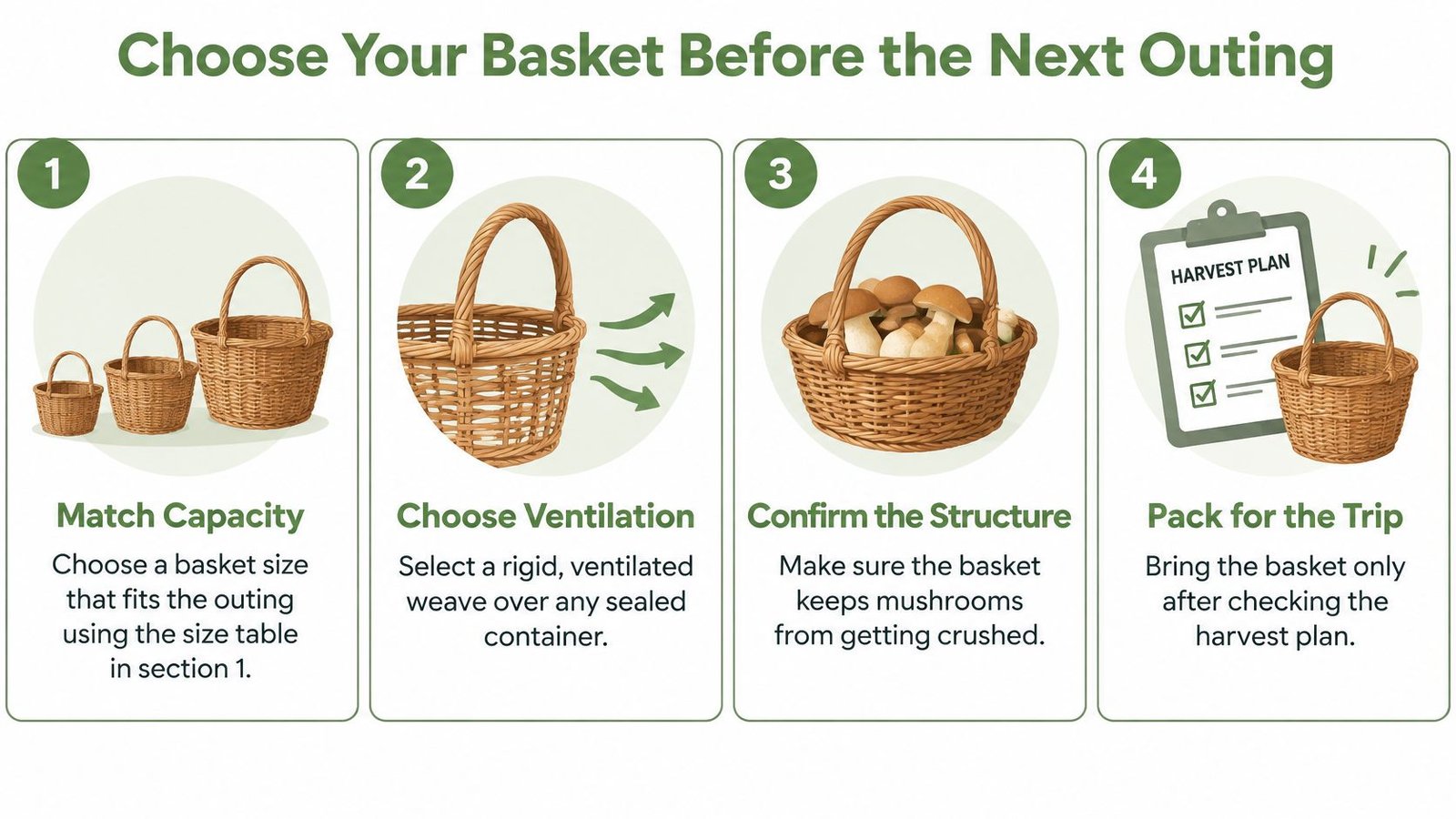
Run this before you buy or pack, and the choice stops being about looks.
- Match capacity to the outing. Half-day single site, 10 to 15 litres. Full day across several species, 20 to 25 litres. Group or multi-day, 30 litres or two baskets.
- Take a rigid, ventilated weave over any sealed container. Airflow and structure together, not one without the other.
- Check the fit. Your paper bags, a knife sheath and a breathable cover should all sit inside without pressing on the load.
- Weigh it empty and try the strap. Comfort at the start of a walk is not comfort at hour four.
- Test it with your own bags, filled to a realistic load, carried for twenty minutes.
Once the checklist passes, the next step is comparing actual options rather than descriptions. Our directory lets you search for mushroom products, services, businesses and events near you or online, then compare and connect directly, and the browse categories cover Dispensaries, Functional Mushrooms, Buy Online, Therapists, Growers and Equipment.
One boundary holds regardless of what you carry. A basket protects specimens and keeps them organised, and it never confirms that a mushroom is edible. Take anything uncertain to an experienced identifier, or to poison-control guidance, before it reaches a pan.
When you're ready to compare gear rather than guess, Mushrooms For Sale gives you one place to search mushroom businesses, equipment and supplies by keyword or location, with listings you can review before you contact a seller. Read the descriptions against the construction points above, especially the weave, the base and the handle clearance, and skip anything sold on a forest-reseeding promise. Start your search at Mushrooms For Sale and pack the basket you'll still be happy to carry at hour four.